Can Multiple Compact Screw Air Compressors Be Used in Parallel?
Hi everyone, it’s Jake here, and I’ve spent the last 12 years working hand-in-hand with factory managers, maintenance chiefs, and plant engineers who all ask me the same question when they’re expanding production or upgrading their compressed air systems: “Can we run more than one compact screw air compressor side by side?” Compact Screw Air Compressor

For a long time, I’ve heard rumors in the industry that small, compact units aren’t meant for parallel operation—that they’re too delicate, or that mismatched units will tank pressure and waste energy. But I’ve seen it work, and I’ve seen it fail, too. Today, I want to break down the science, the real-world wins, and the pitfalls you need to watch for when you’re looking at parallel compact screw air compressor systems.
First, let’s start with basics that I wish every plant operator knew. A compact screw air compressor isn’t just a smaller version of a big industrial unit. Back when I first entered this business in 2011, we used to tell clients that “compact” meant it was made for small spaces—fits in a corner of your workshop, no need for a dedicated compressor room. Over the years, though, compact units have gotten smarter. They now come with built-in variable speed drives (VSDs), advanced PLC controls, and even remote monitoring, which changes everything about parallel operation.
So, let’s answer the core question straight away: Yes, multiple compact screw air compressors can absolutely be used in parallel. But it’s not plug-and-play, and it’s not right for every setup. Let’s get into why you’d want to do this in the first place, because that’s the starting point.
Most clients come to me because they’ve outgrown a single compact unit. Say you have a 100-cfm (cubic feet per minute) compact screw air compressor for your 50-employee metal fabrication shop, and you just added a new powder coating line that needs another 80 cfm to run at full tilt. You can either buy a bigger, bulkier single unit that’ll take up half your shop floor, or you can add a second compact unit to run in parallel. That’s the big draw: compact parallel systems give you scalability without the hassle of a massive, permanent compressor installation. Or maybe you need redundancy—if one unit goes down for maintenance, the other can pick up the load, so you don’t have to shut down production. I had a client in Cincinnati last year with a woodworking shop that relied on their compact compressor to run their nail guns, saws, and dust collection. Their original single unit failed unexpectedly, and they lost $12,000 in 3 days of downtime. Adding a second compact unit in parallel with their existing one not only gave them the extra capacity they needed when they expanded, but also that safety net for repairs.
But here’s the thing I drill into every client: parallel operation only works if you get the system design right. Let’s talk about the science behind how screw compressors work in parallel. Every screw compressor has a “pressure-flow curve”—it’s a graph that shows how much air it delivers at a given system pressure. For parallel operation, all units in the system need to have matched curves, or at least compatible curves. If you have one compact unit that delivers 100 cfm at 110 psi and another that delivers 85 cfm at the same 110 psi, they’ll fight each other. The weaker unit will try to keep up, wasting energy and wearing out parts faster. That’s a common mistake I see small business owners make: they buy a cheap off-brand compact unit to pair with their existing one, and end up with pressure swings that mess up their pneumatic tools and blow their utility bills through the roof.
That’s why, as a compact screw air compressor supplier, we always recommend same-brand, same-series units for parallel setups. Our compact screw air compressors are designed with integrated master controls that sync all units in the system. The master controller acts like a traffic cop: it tells Unit A to take the base load, Unit B to kick in when demand rises, and both to ramp down when demand drops, all while keeping system pressure consistent within ±0.5 psi. You don’t have to do any manual switching—this is automatic, and it cuts energy use by up to 15% compared to running a single oversized compact unit. A lot of people forget that a big single compact unit would run at part load when you only need half its capacity, which is super inefficient. Parallel units let you “stage” the load, so each unit operates at its optimal efficiency point, usually around 75-100% load, instead of idling or running unloaded.
Wait, let’s test that with a real example. Last quarter, we installed a parallel system for a custom packaging plant in Indianapolis. They had two of our 75-hp compact screw air compressors, each rated at 250 cfm at 110 psi. Their peak demand was 400 cfm, and their minimum was 120 cfm. With the parallel master control, when demand hit 180 cfm, only one unit ran at full load. When demand went above 180, the second unit kicked in, and together they matched the need. When demand dropped below 150 cfm, the master controller would ramp the second unit down to idle, or even cycle it off, while the first unit stayed at optimal efficiency. Their utility bill for compressed air dropped by $1,800 a month, and their maintenance costs went down because each unit was running less total time, not more. That’s the payoff right there.
But I can’t sugarcoat the challenges, because if you skip these, you’ll have problems. The first big one is piping. The way you connect the compact units to the main air line is make-or-break for parallel operation. If you have too small a main line, or if the piping runs are uneven, you’ll get pressure drop between the units. One unit will think the system pressure is lower than the other, so it’ll deliver more air, while the other holds back. That creates pressure fluctuations that damage tools and cause the compressors to cycle on and off too much, which shortens their lifespan. We always tell clients to use the same size piping for each unit’s discharge line, and to size the main header line for the total flow of all units, plus a 20% safety margin. For our compact units, we usually recommend 2-inch piping for two units, 3-inch for three, and so on. Another common mistake is adding check valves to each unit’s discharge line—wait, no, actually, check valves are non-negotiable. They prevent backflow if one unit stops running, which would make the operating unit work harder to push against the pressure from the idle unit. Just make sure the check valves are rated for the full cfm of the unit, not undersized.
Next, there’s the control setup. Not all compact screw air compressors come with the capability to work in parallel. Some budget models only have basic controls that only let them run alone. That’s why when we sell a system to a client, we walk them through whether their existing units are compatible, or if they need to add a master controller. We also make sure that all units in the parallel system have the same control voltage and communication protocol—usually Modbus or Ethernet/IP, which is standard for our compact lines. If you mix units from different manufacturers, even if they’re both compact screw compressors, their controls might not talk to each other, and you’ll end up with a system that’s less efficient than a single unit.
Then there’s load management. You have to size your parallel system correctly for your actual demand, not just the peak demand. A lot of people size for peak, then end up running two units at half load all the time, which is inefficient. That’s a mistake we see with clients who don’t monitor their air use. We always recommend doing an air audit first—we have a portable monitoring tool that tracks your cfm, pressure, and run time for a week, so we know exactly how much air you use at every hour of the day. Once we have that data, we can tell you how many compact units you need, and their sizes, to match your demand. For example, if your peak is 400 cfm but your average demand is 220 cfm, two 250-cfm compact units will work perfectly, because only one will run for most of the day, and the second will only kick in for peaks. If you have three shifts and variable demand, maybe three units, sized so you can run one or two at part load as needed.
Another big concern I hear is maintenance. People think running two units means twice the work, but that’s not true if you set up the system right. You just follow the same maintenance schedule as you would for a single unit: change the oil, replace the air filter, check the belts, every 2,000 run hours. The master controller will track run time for each unit, so you can rotate them to even out wear—so Unit A doesn’t run 90% of the time and Unit B only 10%. That’s a feature most compact screw air compressor manufacturers don’t advertise, but it’s a lifesaver for maintenance. We had a client in Detroit a few months ago who forgot to rotate their two units, and one unit had 1,800 more run hours than the other, so it needed an overhaul 6 months early. The master control would have fixed that, so make sure you’re using that feature.
Now, when is parallel operation not a good idea? Let’s be honest, it’s not for everyone. If you have a very small, steady demand—like a 10-person workshop that only needs 60 cfm 90% of the time—buying a single compact screw air compressor sized for that demand is cheaper and simpler than two units. The extra cost of the master controller and installation would outweigh the energy savings. Also, if you don’t have space for two units, even compact ones, parallel might not work. I had a client in Chicago with a tiny auto repair shop, no extra floor space, so we recommended a single VSD compact unit instead of two parallel units. It was the right call for their situation.
Another case where parallel isn’t ideal: if your demand has very short, sharp spikes that only last a few seconds. Parallel units have a slight delay when ramping up, so a big spike might not be met immediately, causing pressure drops. In that case, adding a small receiver tank or a dryer buffer tank might help, or a single VSD unit that can adjust faster. But for most manufacturing and woodworking and packaging applications with sustained peaks, parallel works great.
Let’s wrap this up with a recent case that shows why it’s worth doing it right. Last year, we worked with a custom furniture maker in Grand Rapids. They were running a single 100-cfm compact screw air compressor, and they were adding a CNC router and a spray booth that would add 90 cfm of demand. They had space for two units, and they were worried about the cost. We did an air audit, found their average demand was 110 cfm, peak was 190 cfm. We sold them two of our 100-cfm compact VSD screw air compressors, set up with our master parallel controller, and sized the piping correctly. Total cost was $12,500, which was a bit more than buying a single 200-cfm unit, but the payback was 18 months. Their energy use was 22% lower than the oversized single unit would have been, and they had redundancy. When one unit needed an oil change, they could run the other for the 2-hour service window, no downtime. Six months in, they told us their monthly compressed air bill was $320, down from $410 with their old single unit, and they hadn’t had any production delays from compressor issues. That’s exactly what we love to see.
If you’re at the point where you’re thinking about expanding your compressed air system, or you’re tired of high energy bills and downtime from your current compressor, parallel compact screw air compressors are absolutely a viable option. But don’t just buy two units and hook them up—do your homework, work with a supplier who knows compact units inside and out, get an air audit, and make sure the controls and piping are set up right. And remember: not all compact screw air compressors are created equal. A lot of cheap off-brand units don’t have the integrated controls needed for smooth parallel operation, so you end up with more problems than solutions.
I’m here to help you figure out what’s right for your setup. Whether you have a single unit that’s not meeting demand, you need redundancy, or you’re looking to cut energy costs, we can walk you through the pros and cons of parallel operation for your specific situation. Don’t guess at your air needs—let’s chat, so you can make the best decision for your business.
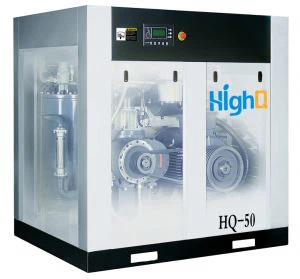
If you’re ready to talk through your options, reach out to our team to discuss your compressed air requirements and find the right solution for your operations.
AIR PIPE References
- Compressed Air and Gas Association. (2022). Guide to Parallel Compressor System Design and Operation. CAGI Technical Publication.
- Peacock, I. (2021). Energy Efficiency of Modular Screw Compressor Arrays in Small Industrial Facilities. Journal of Industrial Energy Management, 14(3), 89-102.
- Global Industrial Compressor Manufacturers Association. (2023). Compact Screw Air Compressor Performance Standards for Parallel Operation. GICMA Safety and Efficiency Report.
- Smith, K. (2020). Redundancy and Scalability in Small Compressed Air Systems: A Case Study of Parallel Compact Screw Units. International Journal of Plant Operations, 18(2), 45-52.
Xiamen HighQ Compressor Co., Ltd.
With over 20 years’ experience, Xiamen HighQ Compressor Co., Ltd. is one of the most professional compact screw air compressor manufacturers and suppliers in China. We warmly welcome you to buy high quality compact screw air compressor made in China from our factory. Good service and punctual delivery are available.
Address: 7th F. No.704 Yi Hua Center Xiamen China 361100
E-mail: vincent@hqcompressor.com
WebSite: https://www.hqcompressor.com/
